Ralf Wipper

Author · Editing · Design

I write about digital systems: why they’re built the way they are, and what they do to people.

Tap anything on the table.

About this passageFrom the German book. An English edition is in preparation.A ping-pong ball, kept in a drawer since he was twelve—and why he won’t throw it out.

Zeit ohne AusgangKapitel 3 · Fallstudie

3.5 Wo der Beobachter aufhört

[…]

In der Schublade liegt ein Tischtennisball, zusammen mit dem Schläger, in einer gemeinsamen Hülle, schon seit dem zwölften Lebensjahr. Vor etwa einem Jahr nahm er ihn zuletzt heraus. Er ist scheinbar wertlos, hohl, ersetzbar, und er war eines der ersten Dinge, die R. sich vom „neuen Westgeld“ selbst gekauft hat.

Warum er ihn nicht wegwirft, hat er in einem Satz beantwortet: Weil er es nicht will.

Denn wenn er die Augen schließt, steht er mit Klassenkameraden an einer Steinplatte und spielt mit diesem Ball. Und kommt diese Erinnerung, kommen die anderen mit — Räume aus denselben und den folgenden Jahren, meist mit Menschen darin. Je länger sie zurückliegen und je weniger präsent sie sonst sind, desto eindringlicher kommen sie.

Das ist der ganze Mechanismus aus dem allerersten Kapitel dieses Buches, an einem Gegenstand, der in eine Hand passt. Ein geschlossener Kreis, für mehr als dreißig Jahre in einer Schublade, jederzeit abrufbar und in voller Größe.

Aus Zeit ohne Ausgang. Warum nichts mehr zu Ende geht, zweiter Teil, Kapitel 3 · Fallstudie, 3.5 Wo der Beobachter aufhört. Unverändert.
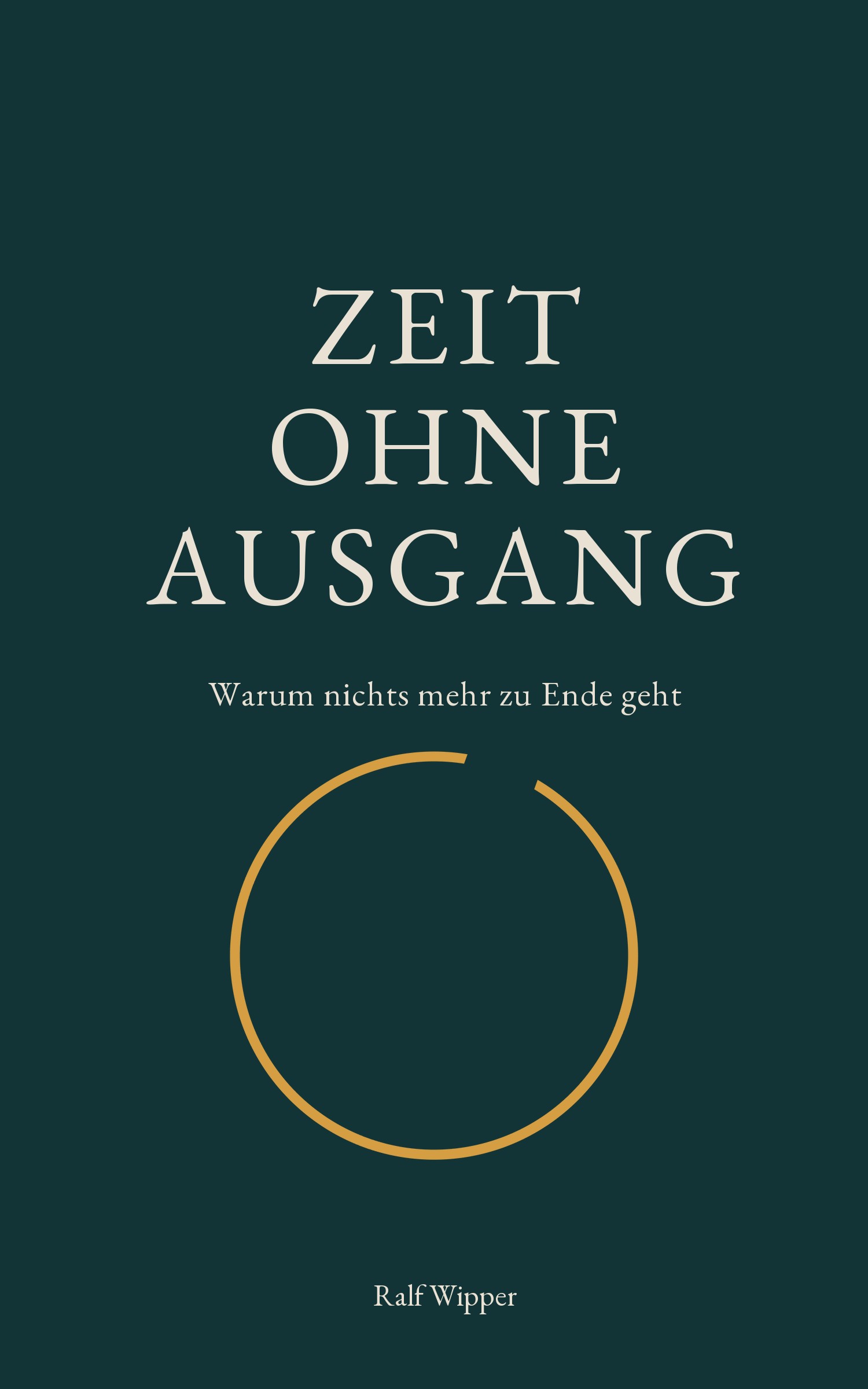
Cover of “Zeit ohne Ausgang. Warum nichts mehr zu Ende geht,” petrol blue with an open ochre ring

Zeit ohne Ausgang

Warum nichts mehr zu Ende geht

The book’s in German, and an English edition is in preparation. The book pages on this site come from the middle chapter and Part Two. They’re in the original German.

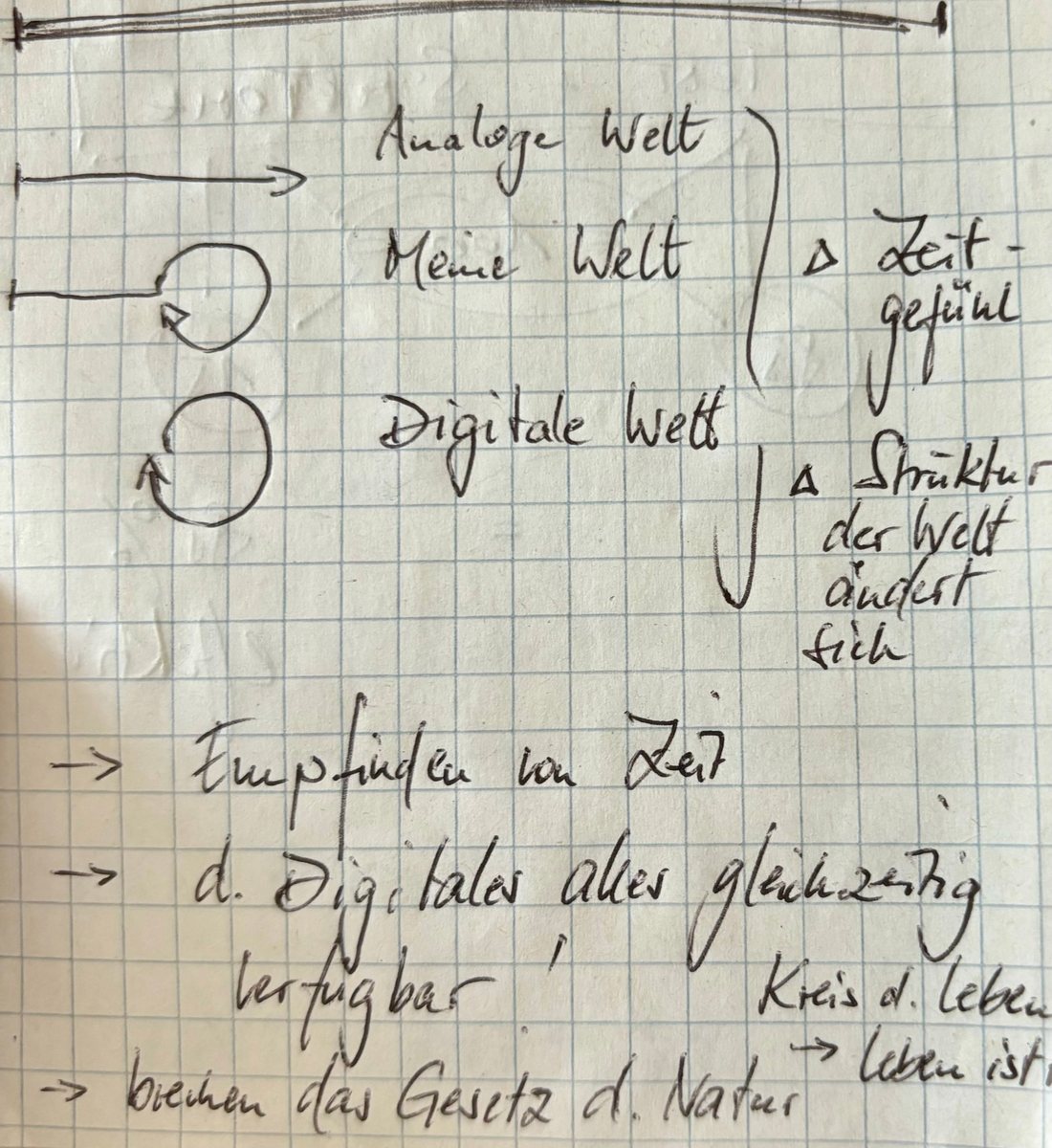
Sheet of graph paper, handwritten in fountain pen, in German. On the left, three signs stacked: a straight arrow, analog world; a line that turns into a loop, my world; a closed circle, digital world. On the right, brackets: delta sense of time, delta the structure of the world changes. Below: how time feels; in the digital, everything available at once; circle of life; we break the law of nature.
Sketch, around 2022

An early sketch

The First Sketch

The idea my book started from, on a sheet of graph paper.

The first line sees the analog world as an arrow: time’s arrow, with the self as a stretch along it. My world is the visible shift from an analog life, one with a direction, to the loop. So my sense of time changed within my own lifetime. The digital world is nothing but total presence in a loop, and that changes the structure of the world as a whole. Everything’s available at once. The old cycle of life is trapped, with no way out. We’re breaking the law of nature.

Early on, it’s all about how time itself changed shape. The book adds the distinctions that matter: being available versus being present, coming back versus being stuck, an edge you set yourself versus an ending someone else sets for you.

About this passageFrom the German book. An English edition is in preparation.East Germany, 1989. The country is changing, and a boy in a Russian-language class reads it first in his teachers’ faces.

Zeit ohne AusgangKapitel 3 · Fallstudie

3.2 Der Raum, der gelesen wird

[…]

Und einmal ist der Raum ein Land.

Er ist in einer Spezialklasse, einer sogenannten R-Klasse, Unterricht auf Russisch, viel Sprachtraining, Strenge. Er steht vor der Lehrerin, die Hand über dem Kopf ausgestreckt, und meldet auf Russisch, dass die Klasse 3R für den Unterricht bereit sei. Den Satz hört er bis heute, sobald er sich dort stehen sieht.

Dann kommt die Wende, und man sieht sie zuerst den Lehrern an, denn für die Kinder selbst war es zunächst nur wie eine Luftveränderung, von der elektrisierenden Sorte. Die Lehrer erklären nichts, aber es steht in ihren Gesichtern: Es ist Angst, und man spürt sie sofort. Die Klasse wird in ein anderes Boot gesetzt, ohne gefragt zu werden. Die Sprache wechselt allmählich von Russisch zu Englisch, eine Spezialklasse bleibt es, nur mit Kindern aus einem anderen alten Bundesland, das man wechselseitig besucht. Die Zeit im Raffer. Jetzt ein Zugabteil, rote Sitze zu einer Liegefläche ausgezogen, die Musterung hinterlässt Abdrücke auf der Haut. Aus den Lautsprechern ertönt Go West.

Aus Zeit ohne Ausgang. Warum nichts mehr zu Ende geht, zweiter Teil, Kapitel 3 · Fallstudie, 3.2 Der Raum, der gelesen wird. Unverändert.

More books

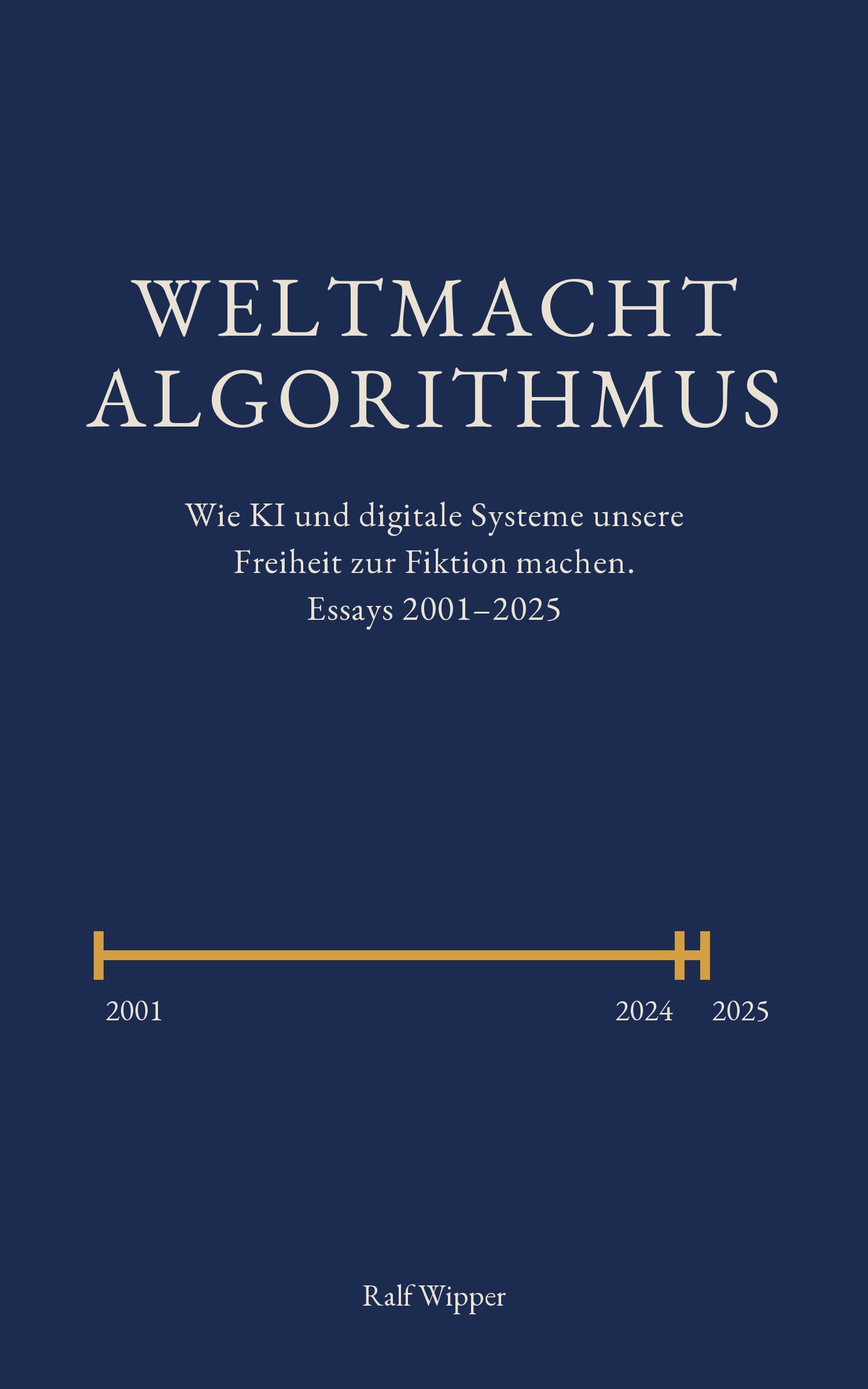
Cover of “Weltmacht Algorithmus,” dark blue with an ochre timeline from 2001 to 2025

Weltmacht Algorithmus

Three essays from 2001 to 2025, held together by one observation: people steered by systems still think they’re free. In German.

Buy on Amazon
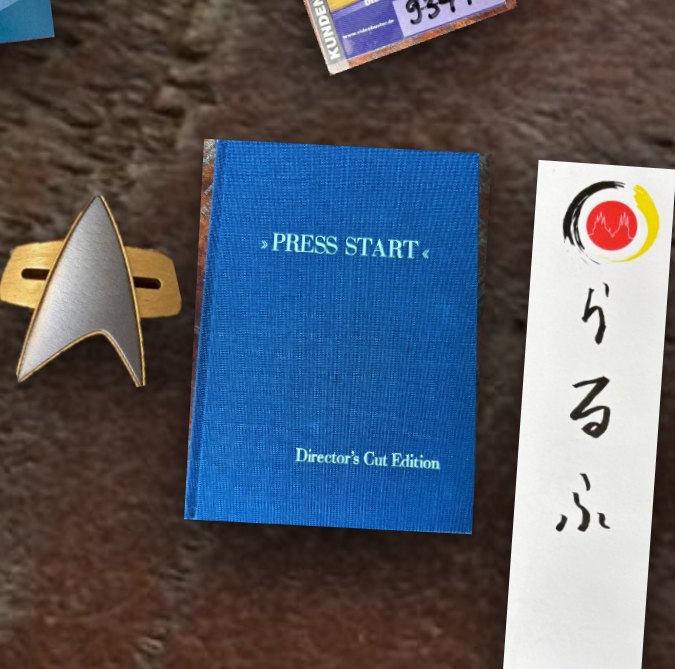
On the table: the blue bound volume “Press Start,” Director’s Cut Edition, next to the communicator and the bookmark

Das Spiel

It sits in the TV stand and gets dusted regularly. I had it bound just for me, a director’s cut, before the work was ever a book. In 2008 it became my first book, Das Spiel. Eine multimediale Erzählung. In German.

On Amazon

Projects

My own productions and work for clients. The older projects were built with teams.

2007–2015 · Independent project

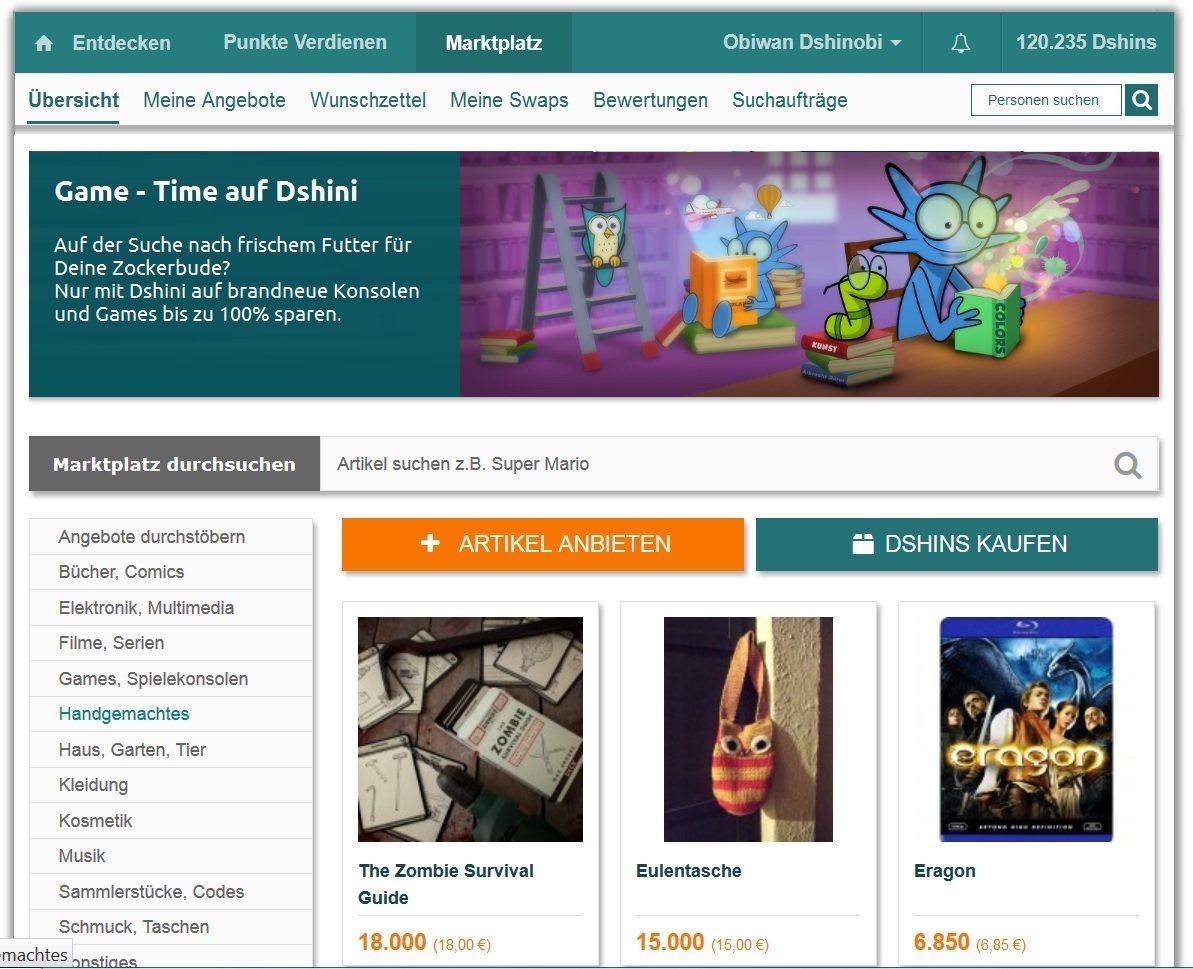
Dshini

A social network with its own currency. Users earned Dshins and traded them for rewards, games, or a donation.

Idea, concept, character, and product development · grew it into a company with two partners

See the project →

Online 2013–2016 · Independent project

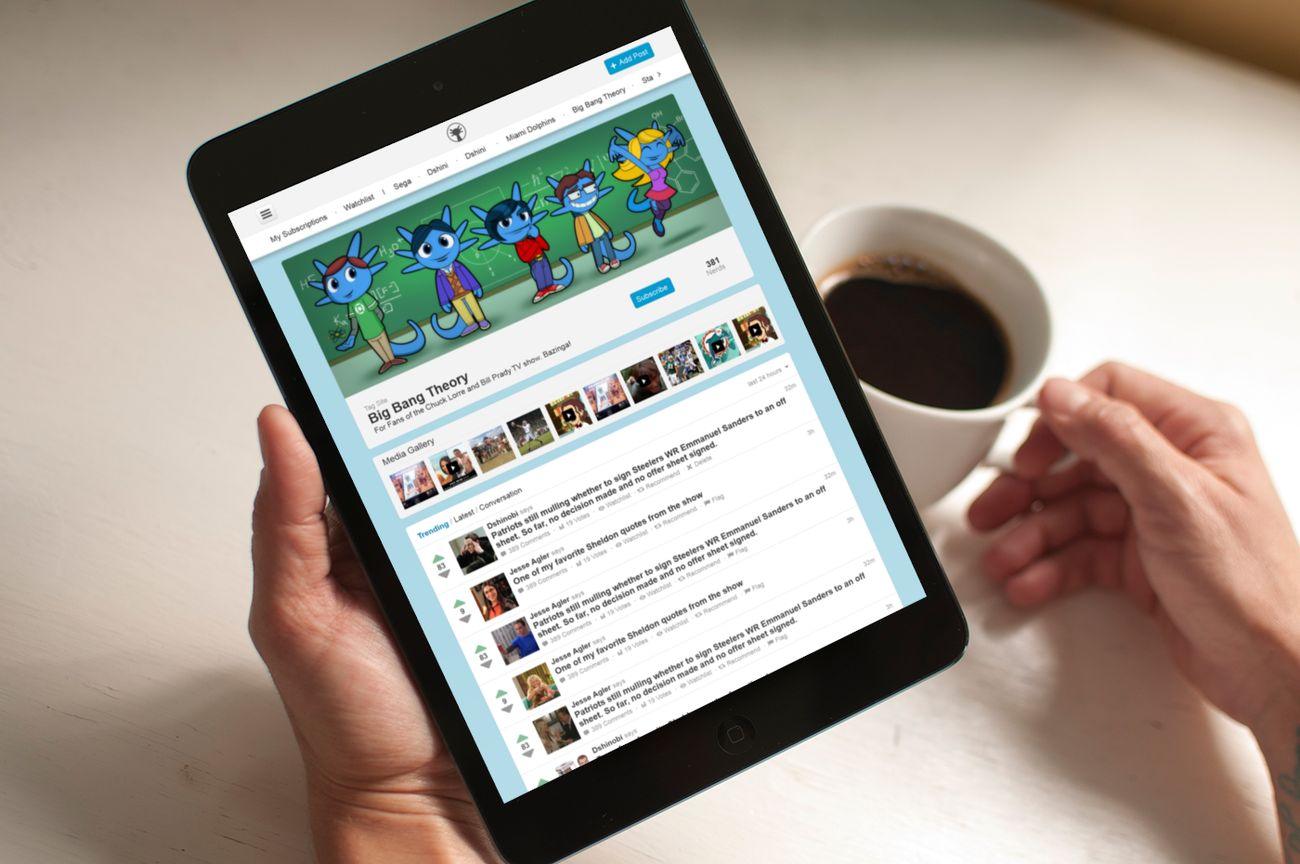
3tags

A platform for discovering, writing, and sharing. It split its ad revenue with the writers and their networks.

Groundwork, name, mascot, and the Content Theory · with my cofounder and our developer

See the project →

2015–2018 · Independent project

Pionic

A magazine about space, science, architecture, and pop culture, almost all of it in English. Three pieces from 2017 lead straight to the later books.

Cofounder and CEO, editor in chief · wrote almost every piece myself

See the project →

2021–2025 · Community project

CyOp

A crypto community in DeFi. I gave it its story—cyberpunk, told like a campfire tale—and came up with NFT cards whose abilities came into play every round.

Name, story, and storyboards · NFT concept

See the project →

Project · since December 2025

Syndcade

A joint project that’s just getting started. My part is the initiation rite: the way you get into the Room.

  • initiation rite
  • ongoing
Syndcade’s glowing S and the SYND/CADE wordmark on a dark background, the large dark shape of the S cut off on the right See where it stands →

Client work · since October 2026 · ongoing

Neuro Somatic Health

For Antje Freysoldt: redesigning the brand, then the website and services. We’re planning a podcast together.

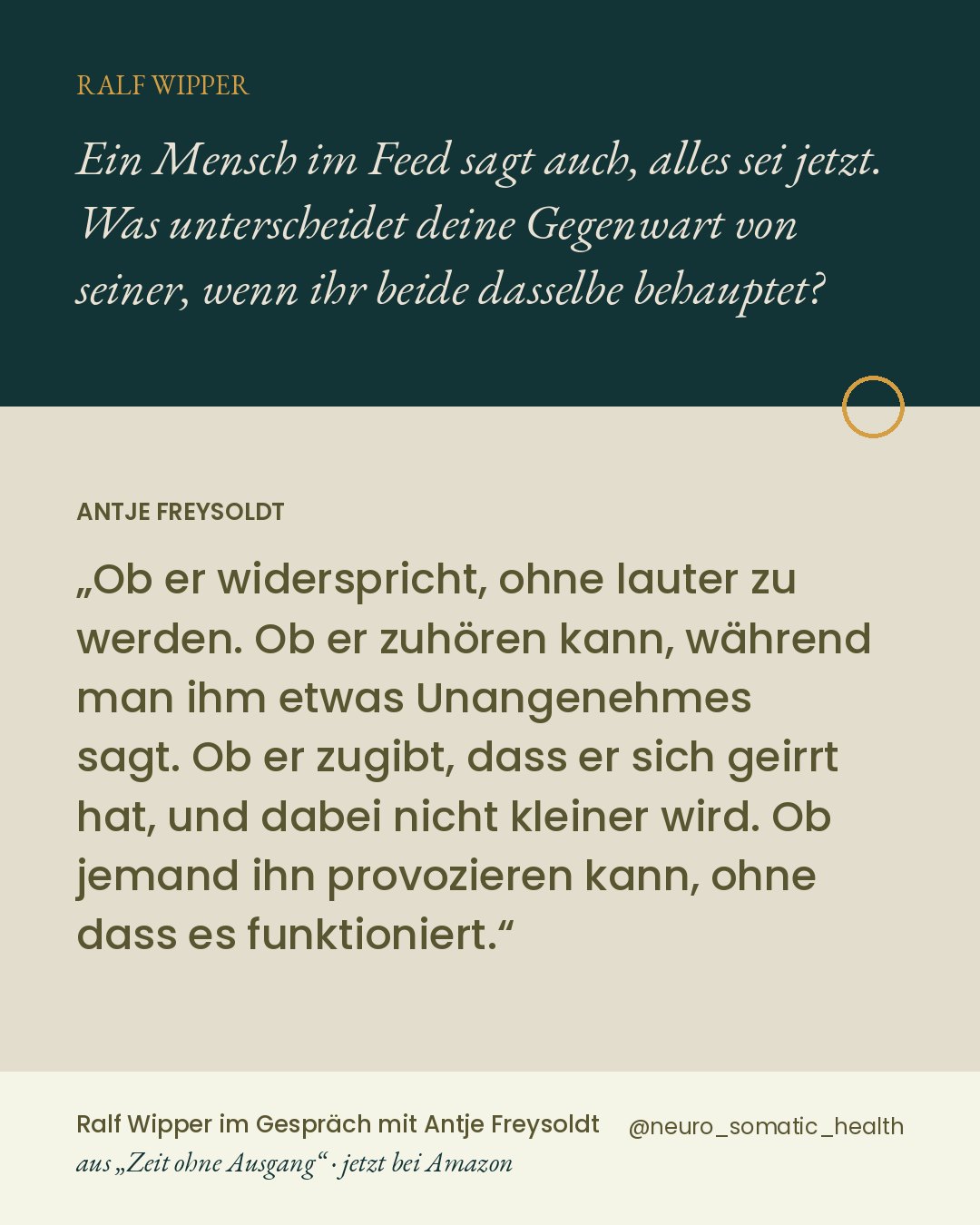
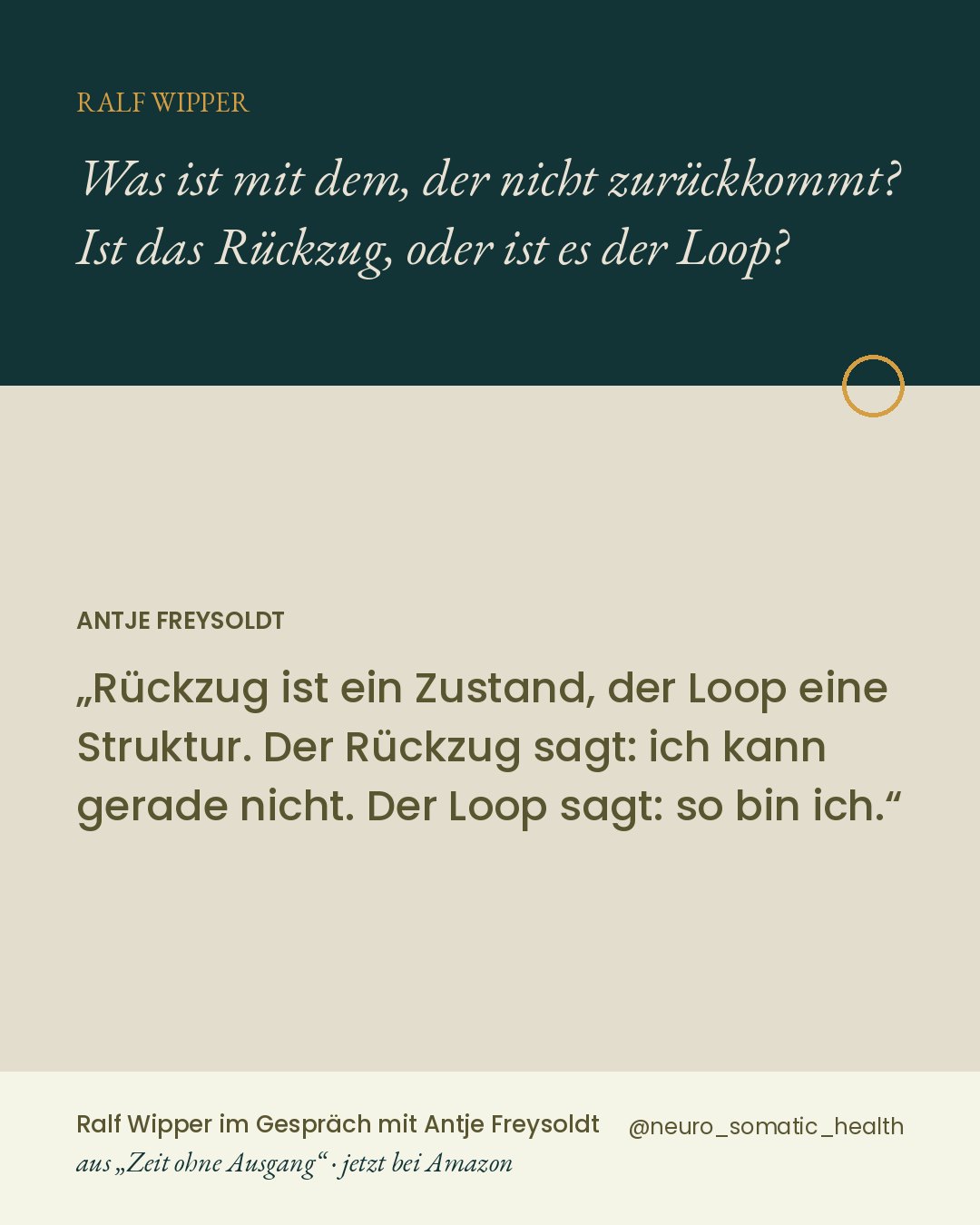
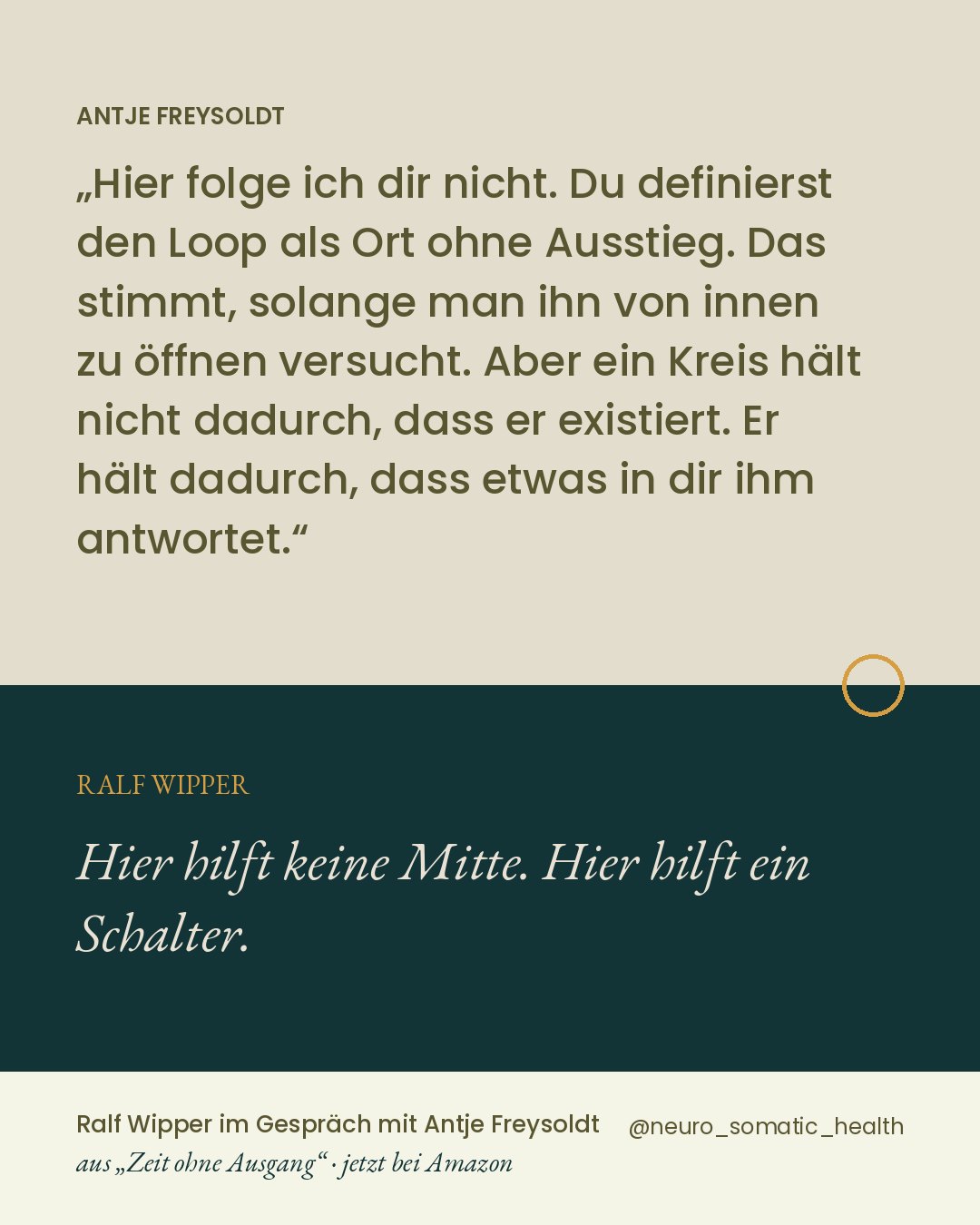
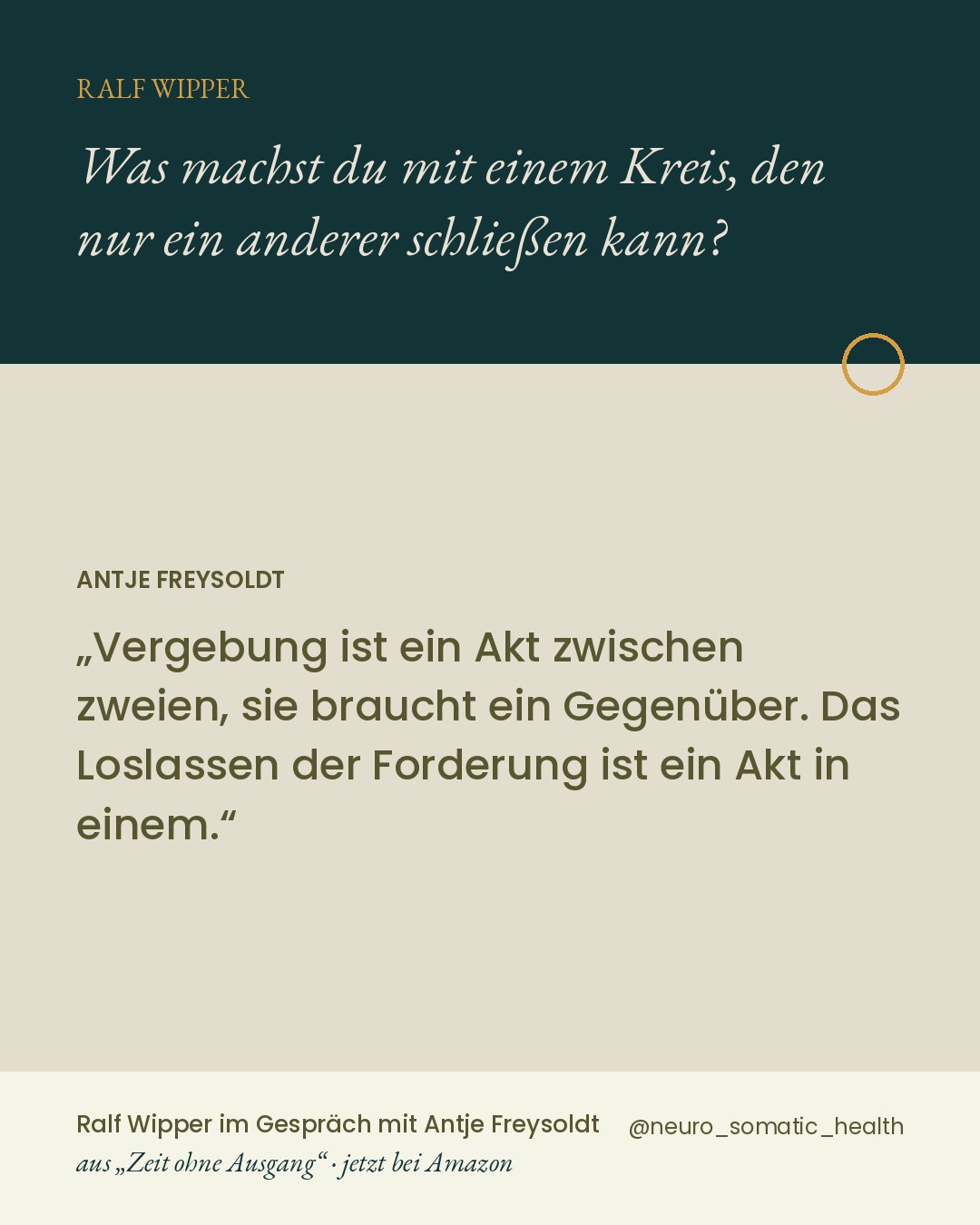
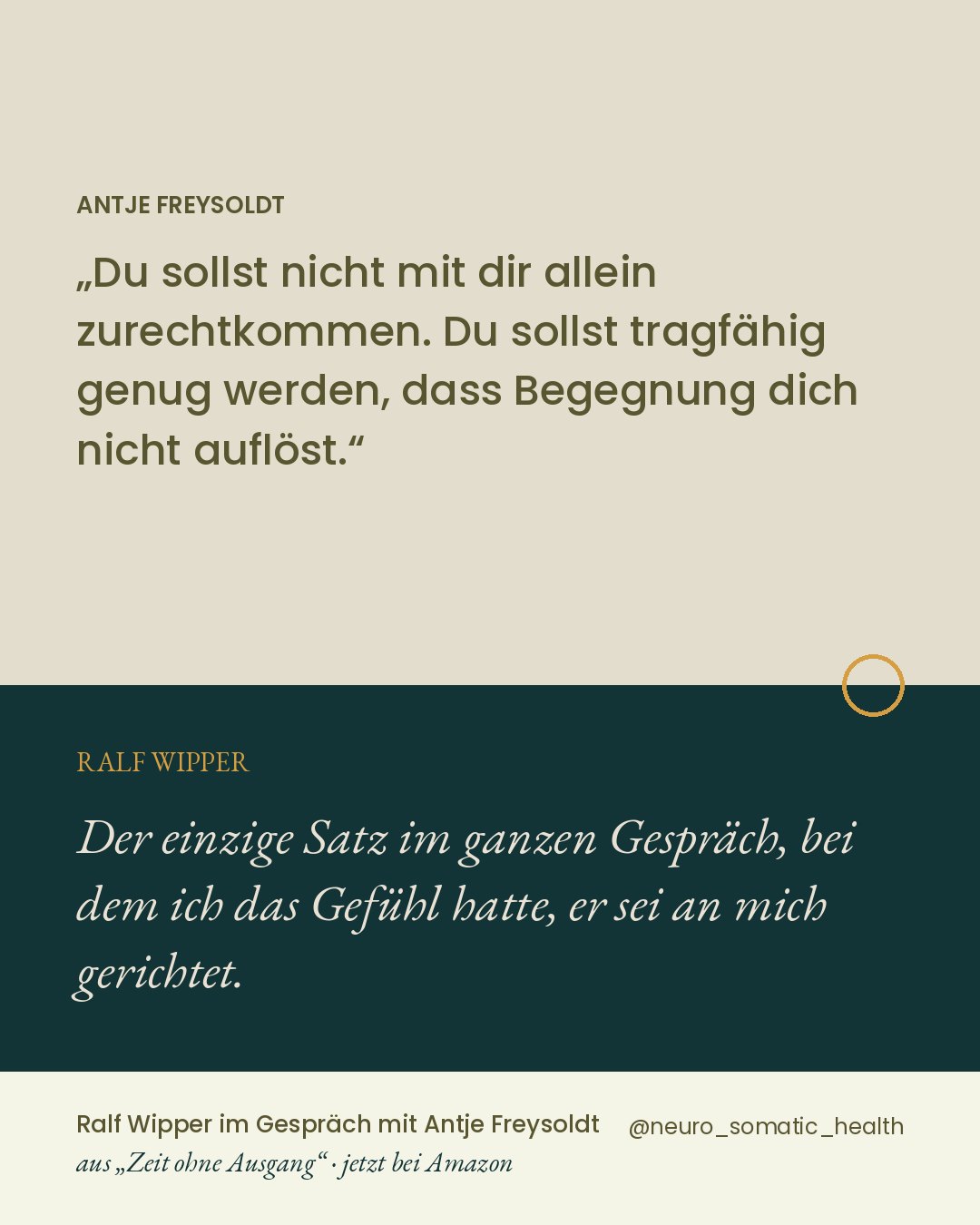
  • Done Five dialogue cards from Zeit ohne Ausgang, October 2026: two voices on one card, her colors and mine. In German.
  • In progress The brand
  • Planned Website, services, podcast
Dialogue card 1 of 5, in German: Ralf Wipper and Antje Freysoldt in conversation about Zeit ohne AusgangDialogue card 2 of 5, in German: Ralf Wipper and Antje Freysoldt in conversation about Zeit ohne AusgangDialogue card 3 of 5, in German: Ralf Wipper and Antje Freysoldt in conversation about Zeit ohne AusgangDialogue card 4 of 5, in German: Ralf Wipper and Antje Freysoldt in conversation about Zeit ohne AusgangDialogue card 5 of 5, in German: Ralf Wipper and Antje Freysoldt in conversation about Zeit ohne Ausgang

Swipe sideways · five cards, 4:5

I develop editorial concepts, writing, and design, for clients too.

Ask about a project

About this passageFrom the German book. An English edition is in preparation.A fedora he owns because of the movies. It doesn’t suit him. He keeps it anyway.

Zeit ohne AusgangKapitel 5 · Schreiben als Anti-Loop

5.5 Die geerbte Oberfläche

[…]

Eines noch: Ich besitze einen Fedora. Ich habe ihn wegen dieser Filme, und ich weiß, dass das ein schwacher Grund ist. Er war einmal Wetterschutz, dann Rang, dann eine Selbstverständlichkeit, die man aufsetzte, bevor man die Wohnung verließ. Nichts davon gilt. Das Bild ist geblieben.

Er steht mir nicht. Ich behalte ihn trotzdem.

Aus Zeit ohne Ausgang. Warum nichts mehr zu Ende geht, zweiter Teil, Kapitel 5 · Schreiben als Anti-Loop, 5.5 Die geerbte Oberfläche. Unverändert.

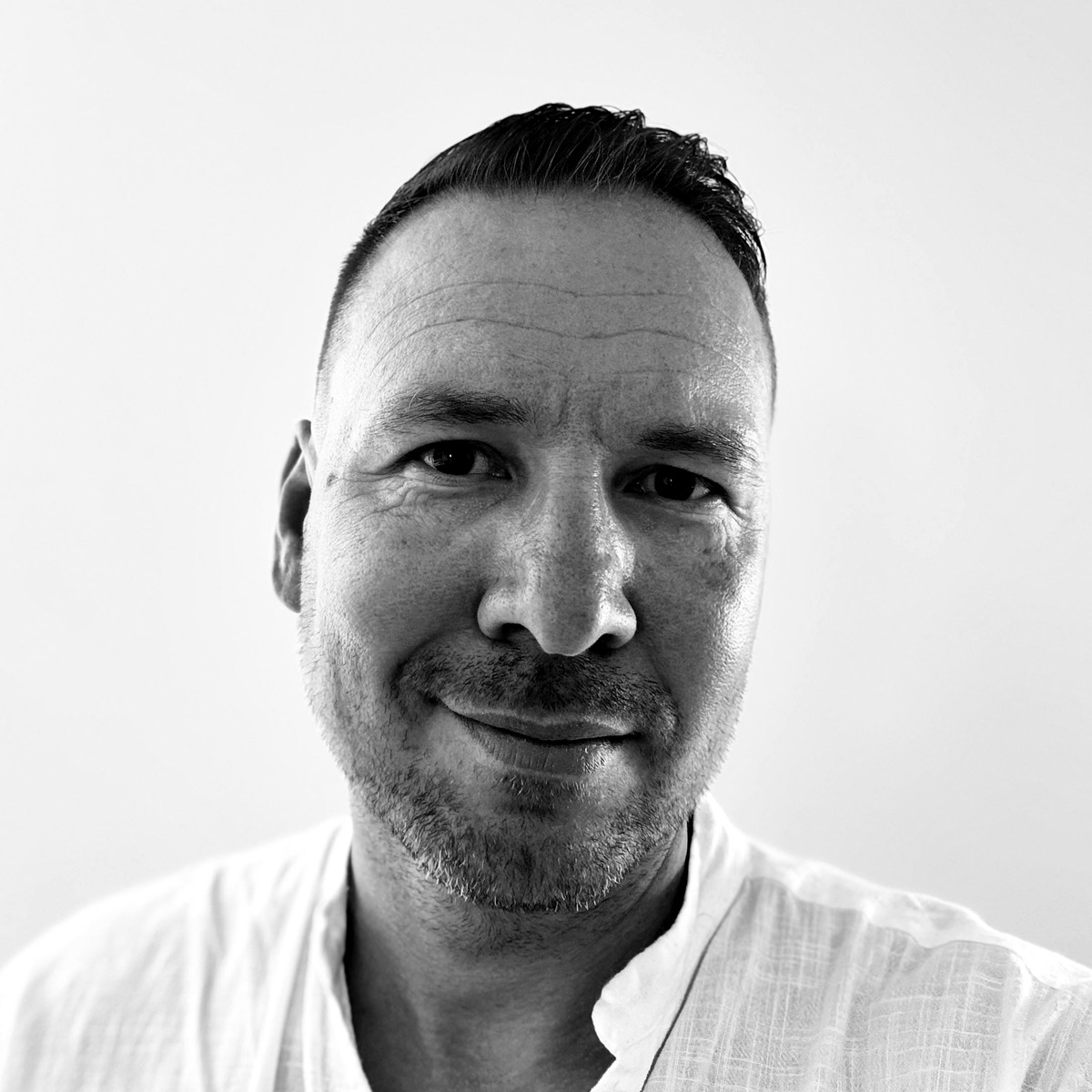
Ralf Wipper, black-and-white portrait: facing the camera, a slight smile, stubble, a light linen shirt against a pale background

About

Ralf Wipper

I often remember in moving pictures. Movies, music, and games have been with me since I was a kid in Thuringia, in what was then East Germany. Video games got me writing. Later I worked in radio and went on camera for a car blog.

My first big piece of work was called Das Spiel, from 2005. In 2008 it became my first book. Writing wasn’t the only thing that pulled me in. Media in all its forms did, so I started my own companies and designed systems and concepts. Dshini was one of them.

After studying media culture, I spent almost twenty years in digital product development, editing, and building platforms. With my teams I made platforms of our own, worlds full of characters, a magazine. At Pionic I was cofounder and CEO, ran the editorial side, and wrote almost everything myself.

Play, freedom, digital systems: those questions still won’t leave me alone. My answers have changed. Zeit ohne Ausgang argues with positions I took myself in Weltmacht Algorithmus.

These days I write books and essays. I also develop editorial concepts, writing, and visual design, for my own publications and for clients. That includes websites: the content, the design, and the build.

Twenty-three things from my table

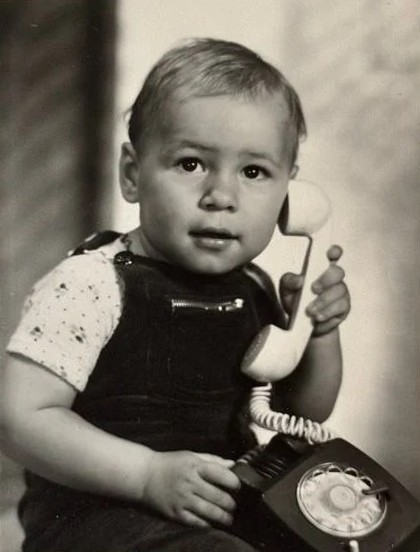
    Black-and-white photo: a toddler holding a toy phone to his ear, taken at a photo studio in Weimar

    Contact

    Fascinated, I stare into the camera. Who could be trying to reach me?

    For client work and questions about the books. If you review books, ask me for a copy. Digital is best.

    Pick up the phone

    23 things